Εμφάνιση αναρτήσεων με ετικέτα Andre Green. Εμφάνιση όλων των αναρτήσεων

Παρασκευή 4 Ιουλίου 2014

The Clinical Approach to The Dead Mother Syndrome

Amy Tuso, With You
[…] The problem in the analysis of the dead mother complex is that another irresistible bargain is forged once we listen in on its secrets. A new covenant is inevitably whispered in the patient’s ear, and we find ourselves offering the analysis as the latest version of an old alliance, as a new dead mother. For who really dares to awaken the dead from their sleep? (p.116)

[…] Andre Green holds out Winnicott’s essay on “The use of an object and relating through identifications” as a model for clinical approaches to the dead mother. Winnicott (1968) leaves an intriguing footnote” “the next task of the worker in the field of transitional phenomena is to restate the problem in terms of disposal” (p.91). […] (p.117)

[…] To coax the subject beyond their funeral vault demands a psychoanalysis of “paradoxical absence”. That is to say the therapeutic task is to raise the possibility of constituting absence, in place of an adherence to undeadness. Yet this absence must re-present an opening out, up, into a potential presence. In Green’s language, the some-thing of absence must take the space of the no-thing that the dead mother “unpresents”(p.122-123)


Sekoff, J (1999) The undead: necromancy and the inner world. In G. Kohon (Ed.) The dead mother: the work of Andre Green (pp. 109-127), London: Routledge

The Secret of the Dead Mother

- Ausencia
- Pintura original de Juan Bielsa
Juan Bielsa, Ausencia
Within her tight embrace the entombed child finds solace, a shelter that offers the certainties of death over the vagaries of life. This is her magical bequest: relief from the anxieties of freedom through submission to a powerful other; sustenance of the omnipotence of holding the life of another in one’s hands; disguise of aggressive intent hidden behind a mask of suffering; and finally I am tempted to say, a terminal holding off in a perpetuity of a recognition of loss. 

For the deepest secret of the dead mother is that she never dies. No one ever has to die. Some secrets are too tempting to resist. A simple trade is sufficient: “give your life over to me now and we will always remain together”. (p.115-116)

[...]What is dead about the dead mother? After all, everything Green points to reminds us that this is a peculiarly lively corpse. Indeed, few of the living exercise such vital power (p.120)

[...] Dead doesn't fully capture the power of this object. We find an object that is more accurately described as "compressing" or "entrapping" rather than lifeless. A centrifuge object whose gravity won't let anything escape. In another vocabulary it is bad rather than absent , whether re-introjecting projections of envy and hatred (Klein), or as a repository of unmet need (Fairbrain). Above all, to borrow an idea of Anne Alvarez (1997), it is a useless object. That is the dead mother fails in its role of providing a refuge of sufficient strenght and flexibility to allow the subject to leave it behind. In sum we find less a dead object, than an object that is deadening (p.121)

[...] Death is not the enemy; the horror is to be suspended between life and death. This is the fate of the dead and deadening object relations of the dead mother complex: to be suspended between the living and the dead. John Steiner (1993) has written of a hald-dead state where both object and self are tormented, but not allowed to die. This state is a psychic retreat from the full measure of guilt and loss that separation from objects entails. In such a state, it is the agency of the subject (an agency brimming with desire, aggression, sex, murder, sufficiency, separatness) that remains suspended. Psychic retreat (or in Jean Wolff Bernstein's felicitous phrase, psychic exile) is an attempt to assuage the angry gods by playing dead (Wold-Besrtein, 1996) (p.122)


Sekoff, J (1999) The undead: necromancy and the inner world. In G. Kohon (Ed.) The dead mother: the work of Andre Green (pp. 109-127), London: Routledge

Πέμπτη 3 Ιουλίου 2014

Dead Mother, Dead Child


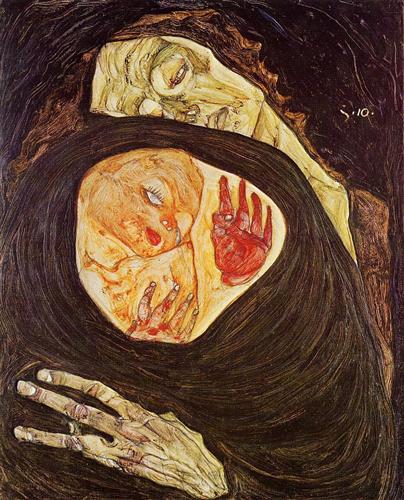
Dead Mother - Egon Schiele
 Egon Schiele, Dead Mother

But is the dead mother’s death not a personal death? How could it be regarded as an event from the real?

Depression often descends upon selves. Although it has a psychic origin and unconscious meaning, it may overcome the self the way a virus grips the soma. The kind of death suffered by the mother in the dead mother complex is also dead as a psychic event at the time of its occurrence; although it has meaning, the meaning is lost to the mother experiencing it. 

 [..] The dead mother refuses her own moods, killing off contact with the processes of inner life. As she dissociated herself from her affects, she stands as a continually stricken witness to the unforeseen misfortunes imposed upon her by lived experience and its after-effects. After-effects are not for her; she is dead to them (p.100)

Green (1983) writes: The transformation in psychical life, at the moment of the mother’s sudden bereavement when she has become abruptly detached from her infant is experienced by the child as a catastrophe; because, without any warning signal, love has been lost at one blow. (p.150)

It was this loss, in one blow that [the patient] presented to me in the transference in the early years of our work; a loss that took the form of a sudden change of his mood, without warning, indeed without any apparent meaningful affective context to himself. His own transformed moods seemed not to be of his own making. And although he acted these blows upon the other, more often and more pertinently, he enacted maternal detachment, by suddenly acting out an apparent passing idea, and abandoning any sentient effort to comprehend himself in the moment of the enactment. (p.104)

[…] the abruptness released by [the patient] was for him a form of self abandonment, a “meaningless” indifference to his own fate. Actions committed by the self seemed not to be of the self. They were the work of some other. And in this respect, such an odd attitude-customarily seen in psychoanalysis as the split –off portion of the personality-was in fact a recollection of an early fact of his life.(p.105)

The catastrophe of abrupt detachment, argues Green (1983), “constitutes a premature disillusionment and…carries in its wake, besides the loss of love, the loss of meaning, for the baby disposes of no explication to account for what has happened (p.150)

Arrested in their capacity to love, subjects who are under the empire of the dead mother can only aspire to autonomy. Sharing remains forbidden to them. Thus, solitude, which was a situation creating anxiety and to be avoided, changes sign. From negative it becomes positive. Having previously been shunned, it is now sought after. The subject nestles into it. He becomes his own mother, but remains prisoner to her economy of survival. He thinks he has got rid of his dead mother. In fact, she only leaves him in peace in the measure the she herself is left in peace. As long as there is no candidate to the succession, she can well let her child survive, certain to be the only one to possess this inaccessible love. (Green, 1983, p.156) (p.105)

Bollas, C (1999) Dead mother, dead child. In G. Kohon (Ed.) The dead mother: the work of Andre Green (pp. 87-108), London: Routledge

Τετάρτη 2 Ιουλίου 2014

The Phenomenology of the Dead Mother Syndrome


[…]The dead mother syndrome remains one of the most difficult therapeutic problems that an analyst can encounter. Green reports that in a successful analysis the patient may recover memories of a period of aliveness that preceded the mother’s depression. 

My own cases suggest a somewhat different scenario: the mother’s deadness is not experienced as a discrete episode with a beginning and an end, so that I have not been able to recover memories of a period where the mother was emotionally available. 

From the perspective of the patient’s reconstruction of their mother, the mother may be perceived as someone with a permanent characterological deficit, rather that remembering their mother as having suffered from a time-limited depression. Furthermore, in some cases my patients do not necessarily recognize the mother’s depression as such.

In some instances it would appear as if their mother was unable to recognize that her child had an inner life that was separate and distinct from her own. […] The consequences of experiencing this failure […] can be devastating. For recognizing the uniqueness of children’s inner life is equivalent to recognizing that they are psychically alive. It is as if their mothers failed to acknowledge their humanity […] The child has not been granted the  permission to be a person [which] may result in the conviction that all desires are forbidden, for if one does have a right to exist one has no right to have desires, to want anything for oneself. (p.77-78)

[...] Stern (1994) observed the infant’s microdepression resulting from its failed attempts to bring the mother back to life. “After the infant’s attempt to invite and solicit the mother to come to life, to be there emotionally, to play have failed, the infant, it appears, tries to be with her by way of identification and imitation”(p.13). This observation is consistent with Green’s report that his patients suffered from a primary identification with the dead mother. It is as if the patient is saying: “If I cannot be loved by my mother, I will become her”

Many patients avoid the dead mother syndrome by a counter-identification, becoming the opposite of the mother, or believing that only a part of themselves is dead, thus retaining a sense of individuality and preserving a sef/object distinction. In contrast in cases of primary identification the patient’s individuality is completely lost as she becomes submerged with the mother that she has constructed.[…] This total identification with a dead mother who is incapable of loving contributes to a corresponding incapacity to love others and love oneself. (p.78)

There is another aspect of the phenomenology of the dead mother syndrome [that] relates to the processing of affects. It is commonly recognized that a disturbance in the early mother/infant or mother/child relationship contributes to a relative incapacity to regulate affects[…]This disturbance in affect regulation my arise from a non-specific asynchrony in the mother/child relationship, consistent with Bion’s theory that the mother is the container and initial processor of the child’s anxiety. 

One observes the fear of experiencing intense feelings with the belief that, insasmuch as affects are inherently uncontrollable, the self would be flooded and overwhelmed. If the mother is emotionally unresponsive, one may infer that she has distantanced herself form her body and bodily experiences. If this should prove to be the case, this dissociation between the self and the body will be communicated to the child, and the mother will therefore, prove to be relativel unable to facilitate the child’s processing of his/her own affective experiences.

[...]What may be more specific to the dead mother syndrome is an inability to experience pleasure. This is different from what is ordinarily understood as a masochistic compulsion to seek pain. Pleasure itself, the pleasure of simply being alive, is missing. More than that, in some instances that pleasure can be derived from any source, no matter how innocent, is forbidden. If pleasure is inadvertently experienced it must be punished. […] (p.79)

Those patients who suffer form the dead mother syndrome evidence great difficulties in “being with the other”. Green (1983) alluded to this when he commented that “the patient it strongly attached to the analysis more than the analyst” (p.161). The patient does not know how to be with the analyst. In some cases it is felt to be dangerous to even aknowledge a relationship to the analyst […] hence they become dead and lifeless in the analytic setting. They maintain a corpse-like posture, do not move on the couch and speak in a dead-seeming voice drained of all affective valence. This deadness may prove to be contagious and infect that analyst who may find himself also speaking in a dull lifeless monotone. The dead mother is a ghost which pervades the entire analytic process.(p.79-80)


Modell, A.H. (1999) The dead mother syndrome and the reconstruction of trauma. In G. Kohon (Ed.) The dead mother: the work of Andre Green (pp. 76-86), London: Routledge