 |
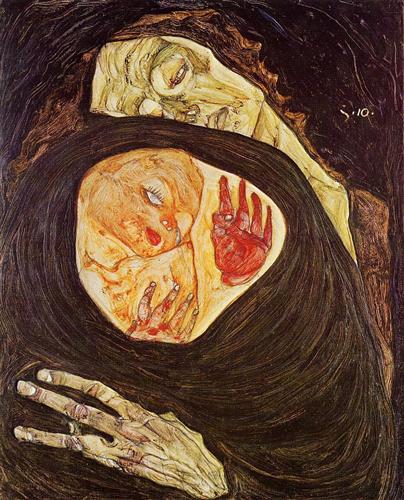
| Egon Schiele, Dead Mother |
But is the
dead mother’s death not a personal death? How could it be regarded as an event
from the real?
Depression often descends upon selves. Although it has a psychic origin and unconscious meaning, it may overcome the self the way a virus grips the soma. The kind of death suffered by the mother in the dead mother complex is also dead as a psychic event at the time of its occurrence; although it has meaning, the meaning is lost to the mother experiencing it.
[..] The dead mother refuses her own moods, killing off contact with the processes of inner life. As she dissociated herself from her affects, she stands as a continually stricken witness to the unforeseen misfortunes imposed upon her by lived experience and its after-effects. After-effects are not for her; she is dead to them (p.100)
Green (1983) writes: The transformation in psychical life, at the moment of the mother’s sudden bereavement when she has become abruptly detached from her infant is experienced by the child as a catastrophe; because, without any warning signal, love has been lost at one blow. (p.150)
It was this
loss, in one blow that [the patient] presented to me in the transference in the
early years of our work; a loss that took the form of a sudden change of his
mood, without warning, indeed without any apparent meaningful affective context
to himself. His own transformed moods seemed not to be of his own making. And
although he acted these blows upon the other, more often and more pertinently,
he enacted maternal detachment, by suddenly acting out an apparent passing idea,
and abandoning any sentient effort to comprehend himself in the moment of the
enactment. (p.104)
[…] the
abruptness released by [the patient] was for him a form of self abandonment, a “meaningless”
indifference to his own fate. Actions committed by the self seemed not to be of
the self. They were the work of some other. And in this respect, such an odd
attitude-customarily seen in psychoanalysis as the split –off portion of the
personality-was in fact a recollection of an early fact of his life.(p.105)
The
catastrophe of abrupt detachment, argues Green (1983), “constitutes a premature
disillusionment and…carries in its wake, besides the loss of love, the loss of
meaning, for the baby disposes of no explication to account for what has
happened (p.150)
Arrested in
their capacity to love, subjects who are under the empire of the dead mother
can only aspire to autonomy. Sharing remains forbidden to them. Thus, solitude,
which was a situation creating anxiety and to be avoided, changes sign. From negative
it becomes positive. Having previously been shunned, it is now sought after.
The subject nestles into it. He becomes his own mother, but remains prisoner to
her economy of survival. He thinks he has got rid of his dead mother. In fact,
she only leaves him in peace in the measure the she herself is left in peace.
As long as there is no candidate to the succession, she can well let her child
survive, certain to be the only one to possess this inaccessible love. (Green,
1983, p.156) (p.105)
Bollas, C
(1999) Dead mother, dead child. In G. Kohon (Ed.) The dead mother: the work of Andre Green (pp. 87-108), London: Routledge

