Κυριακή 6 Ιουλίου 2014

The Mutant Self

Scott Greenwalt, Shrouded Mutation
Event-traumatised individuals live in a rather suspended state, defined in part by the intrusion of the real into the personal[…] (p.95)

[The word mutant] is an apt description of a self that was changed by a sudden event. (p.97)

These people are often schizoid personalities [and they seem] to recall easily the period of self-mutation. Knowing they have endured a change to their personality, such individuals must call upon a certain kind of personal parenting to hold themselves together, lest their new character break into its own form of madness. Schizoid stiffness […] is an effort on the part of the ego, to hold the mutational self in place.

People who feel they mutationally changed rather that psychodevelopmentally evolved convey this sense of fatedness by creating a curious atmosphere around themselves, achieved through odd gestures, idiosyncratic movements and curious verbalizations of their states of mind, which give off the feel of an impeding climactic change. Something is in the air. Something may be on the verge of happening. The world is not to be taken for granted. (p.97)

[…] The individual who is altered by trauma transforms this deficit into the structure of a wish and henceforth seeks dramatic events as the medium of self transformation. […] The child who has been mutated by the event develops an attachment, therefore, to the nature of mutational eventfulness rather that to the presence of the other. They seek malignant events like some seek relations with people. (p.100)

[…] the individual lives now outside himself, considering himself an outsider. Thrown into the outside by the structure of events, he now is there in the place where it happened, and in that place he observes the self that is mutilated by the course of events. He carries the structure of his phenomenon within himself. Sometimes [the patient might startle another person and bring about a dissociated moment[…] interrupting the other’s harmonic relation to themselves as an object, throwing them outside the internal place into looking at the actual other, looking at themself through the imagined eyes of the other, now quite uneasy about what would happen. (p.102)

Bollas, C (1999) Dead mother, dead child. In G. Kohon (Ed.) The dead mother: the work of Andre Green (pp. 87-108), London: Routledge 

Σάββατο 5 Ιουλίου 2014

The Analytic Setting as a Representation of the Internal Mental Structure


Painter Wassily Kandinsky. Black and Violet. 1923
Wassily Kandinsky, Black and Violet

The analytic setting as a representation of the mind in a dream-state has been explored by several writers, notably Lewin(1955).He comments that the analytic setting arose historically out of the setting for hypnosis[…]. So there was from the beginning a relation between the structure of the analytic setting and sleep, censorship and resistance. (p. 64)

Freud (1900) himself commented that free association resembles the state of mind that precedes sleep and if the patient on the couch is a quasi-sleeper or a quasi-dreamer, it is free association that represents the uncensored activity of the unconscious, pushing forward to express material which in turn provokes censorship.  The conflict between free association and resistance, so fundamental to the analytic setting, exactly represents the intra-psychic conflict and censorship that give rise to the latent and manifest content of dreams.  The analyst, whose awareness makes bridges between the latent and the manifest material, is in the position of the sleeper’s ego that can articulate the dream work, releasing and organizing the unconscious wishes (Khan, 1974). The analyst works in the reverse direction, however, trying to see through the defences, not keep them in place, and is therefore an “awakener” rather than a guardian of sleep (Lewin, 1955) (p.65)

Andre Green […] has shown how the analytic setting is a representation of the Oedipus Complex:
The symbolism of the setting comprises a triangular paradigm, uniting the three polarities of the dream (narcissism), of maternal caring (from the mother, following Winnicott) and of the prohibition of incest (from the father, following Freud). What the psychoanalytic apparatus gives rise to, therefore, is the symbolization of the unconscious structure of the Oedipus Complex (Green, 1984, p. 123)

One aspect of the analytic situation is the peaceful, reliable environment, the lying down, the invitation to say anything and express any wish or feeling, without censoring it. The analyst who offers these is inviting the patient to regress and be cared for in a state of dependence. But there are other aspects, such as the prohibition on enacting wishes or feelings, the rigour and constraints about session times and payment of fees, and the analyst’s refusal to accept at face value what the patient offers him. This is what Friedman (1997, p.30) call the “adversarial” quality of analysis, and the analyst who embodies it is a different object for the patient from the one that offers regression.

The analyst thus represents two opposite sorts of object at the same time. The patient’s wish is to separate them out and to be able to relate to one of them but not the other. But these two objects have their own relationship with each other. There is a union between them in the person of the analyst, which the patient is not privy to. The patient has to accept this, and find a way of relating to both of them together, despite the wish to keep them apart and establish a special relationship with just one. These two objects are both located, in their externalized forms in the analyst, but they are also fundamental to the structure of the patient’s internal world . (p.65-66)

The nature of the analytic framework […] represents in its own structure the unconscious structure of the Oedipus Complex just as it does the internal state of the dreamer. These examples [...]show what it means for the structure of the psychoanalytic situation to be an external representation of internal psychic structure. (p.66)


Parsons, M.( 1999) Psychic Reality, Negation, Analytic Setting. In G. Kohon (Ed.) The dead mother: the work of Andre Green (pp. 59-75), London: Routledge

The Analytic Stance: Psychic Reality vs.Ordinary Reality

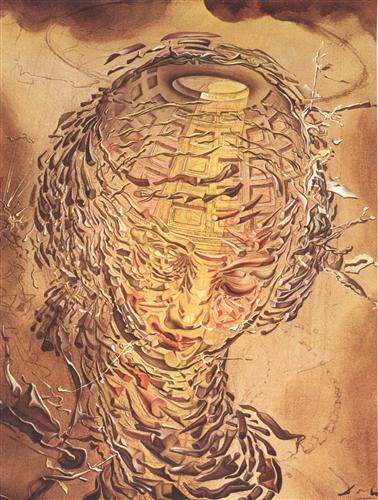
Raphaelesque Head Exploding - Salvador Dali
Salvador Dali, Raphaelesque Head Exploding
Ordinary reality does refer to the encounters and events we experience in external reality. But the feelings, hopes and anxieties which comprise our internal experience are also part of our ordinary reality. These too are experiences we have, or which happen to us. By ordinary reality I mean the ensemble of our internal and external realities, as we experience them.

Psychic reality is the realm where we reflect on what happens to us. Our psychic reality is constituted by what we make (consciously and unconsciously) of our experiences, both internal and external. For that to happen, for us to have a psychic reality at all, some kind of representation of our experience is necessary. If we have no way of representing to ourselves what we experience, we cannot process it   […]. 

A large part of psychoanalysis lies in helping the patient create a psychic reality out of ordinary reality, by discovering how to represent this experience to himself so that the psychical transformation of that experience becomes possible (p.62)

"Maintaining an analytic stance” means actively holding on to a particular frame of mind..[…] Keeping oneself attuned to the realm of psychic reality rather than ordinary reality requires a particular sort of effort. There is resistance to overcome. [...] (p.59) A resistance to the pull of ordinary reality so as to stay in the realm of psychic reality. Particularly when patients do not speak from their psychic reality but use ordinary reality defensively, the analyst must work all the harder to hold a position within the psychic reality, knowing that that is where the analytic work is done. (p.61)

[...] With the disappearance of something which belongs to ordinary, sitting-up, conversation-like reality, space is made for something different.[...] The lying down, the frequency and the silence are all examples of how the analytic situation is set up so as to embody the negation of ordinary reality.[..](p.68)


Parsons, M.( 1999) Psychic Reality, Negation, Analytic Setting. In G. Kohon (Ed.) The dead mother: the work of Andre Green (pp. 59-75), London: Routledge 

Παρασκευή 4 Ιουλίου 2014

The Clinical Approach to The Dead Mother Syndrome

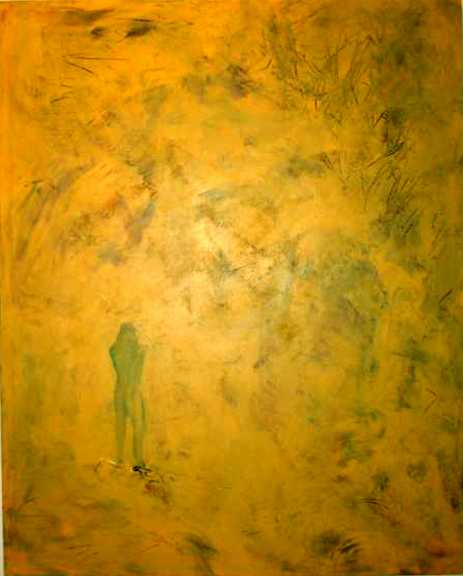
Amy Tuso, With You
[…] The problem in the analysis of the dead mother complex is that another irresistible bargain is forged once we listen in on its secrets. A new covenant is inevitably whispered in the patient’s ear, and we find ourselves offering the analysis as the latest version of an old alliance, as a new dead mother. For who really dares to awaken the dead from their sleep? (p.116)

[…] Andre Green holds out Winnicott’s essay on “The use of an object and relating through identifications” as a model for clinical approaches to the dead mother. Winnicott (1968) leaves an intriguing footnote” “the next task of the worker in the field of transitional phenomena is to restate the problem in terms of disposal” (p.91). […] (p.117)

[…] To coax the subject beyond their funeral vault demands a psychoanalysis of “paradoxical absence”. That is to say the therapeutic task is to raise the possibility of constituting absence, in place of an adherence to undeadness. Yet this absence must re-present an opening out, up, into a potential presence. In Green’s language, the some-thing of absence must take the space of the no-thing that the dead mother “unpresents”(p.122-123)


Sekoff, J (1999) The undead: necromancy and the inner world. In G. Kohon (Ed.) The dead mother: the work of Andre Green (pp. 109-127), London: Routledge

On the Significance of Absence


Certain patients, or better psychical constellations, come to revolve around the proposition that “all I have got is what I have not got”. This negative presence becomes the gravity of a psyche founded upon loss. [...]. 

For Green, Bion and Winnicott the absent other marks the place, names the conditions which allow thought, being or vitality to move forward or inversely, becomes the graveyard of the subject, where attacks on linking(negative K) (Bion, 1959), unintegration (Winnicott, 1963) or madness (Green, 1986c) reign. 

Absence may seize hold of us, shadow us, propel us toward oblivion, yet absence is also constitutive, creative, a necessary condition for vital and alive psychic life. “Absence is an intermediary situation between presence (as far as intrusion) and loss (as far as annihilation)” (Green, 1986a, p.50), “In this context, absence does not mean loss, but potential presence”(Green, 1986b, p.293)

To constitute absence may be among our most vital tasks. For Bion,  thought, love and transformation exist only in relation to their negatives. The absent (to be without memory or desire) is a call to the potential emergence of the positive. Winnicott treasured the place not to be communicated, the solitude that allows self-emergence, and the destructiveness that embodies the other as separate and apart from ourselves. For his part, Green elevates the absence to a form of creative structure.

[…]The potential space created within this frame allows a subjectivity to emerge, with its vital affects and thoughts intact. By way of negative demonstration, he depicts the dead mother as never absent, overfilling an inadequate psychic space.[….] Nothing can truly enter this dense space, and nothing can truly emerge from it.[…] Only absence allows new thought and fresh experience.  (p.114)

[…] The analytic work must be balanced between a project of representing absence and offering a framing structure of its own, a psychic envelop (Anzieu, 1990) constituted through the homologues of the analytic object. Only living under, within, and between the skin (and skin-ego) of the analytic couple may an alternative to the grim offerings of the dead mother be sought. (p.115)

Sekoff, J (1999) The undead: necromancy and the inner world. In G. Kohon (Ed.) The dead mother: the work of Andre Green (pp. 109-127), London: Routledge

The Secret of the Dead Mother

- Ausencia
- Pintura original de Juan Bielsa
Juan Bielsa, Ausencia
Within her tight embrace the entombed child finds solace, a shelter that offers the certainties of death over the vagaries of life. This is her magical bequest: relief from the anxieties of freedom through submission to a powerful other; sustenance of the omnipotence of holding the life of another in one’s hands; disguise of aggressive intent hidden behind a mask of suffering; and finally I am tempted to say, a terminal holding off in a perpetuity of a recognition of loss. 

For the deepest secret of the dead mother is that she never dies. No one ever has to die. Some secrets are too tempting to resist. A simple trade is sufficient: “give your life over to me now and we will always remain together”. (p.115-116)

[...]What is dead about the dead mother? After all, everything Green points to reminds us that this is a peculiarly lively corpse. Indeed, few of the living exercise such vital power (p.120)

[...] Dead doesn't fully capture the power of this object. We find an object that is more accurately described as "compressing" or "entrapping" rather than lifeless. A centrifuge object whose gravity won't let anything escape. In another vocabulary it is bad rather than absent , whether re-introjecting projections of envy and hatred (Klein), or as a repository of unmet need (Fairbrain). Above all, to borrow an idea of Anne Alvarez (1997), it is a useless object. That is the dead mother fails in its role of providing a refuge of sufficient strenght and flexibility to allow the subject to leave it behind. In sum we find less a dead object, than an object that is deadening (p.121)

[...] Death is not the enemy; the horror is to be suspended between life and death. This is the fate of the dead and deadening object relations of the dead mother complex: to be suspended between the living and the dead. John Steiner (1993) has written of a hald-dead state where both object and self are tormented, but not allowed to die. This state is a psychic retreat from the full measure of guilt and loss that separation from objects entails. In such a state, it is the agency of the subject (an agency brimming with desire, aggression, sex, murder, sufficiency, separatness) that remains suspended. Psychic retreat (or in Jean Wolff Bernstein's felicitous phrase, psychic exile) is an attempt to assuage the angry gods by playing dead (Wold-Besrtein, 1996) (p.122)


Sekoff, J (1999) The undead: necromancy and the inner world. In G. Kohon (Ed.) The dead mother: the work of Andre Green (pp. 109-127), London: Routledge